Pages

Tuesday, 19 February 2019

Norfolk Bay and the Wooden Boat Festival


Monday, 4 February to Monday 11, February 2019
It was an 0630 start on Monday from Maria Island to time our transit of the Denison Canal for slack water, 2 hours 20 minutes after Hobart high tide. The canal was opened in 1905 to shorten the route between the east coast and Hobart and largely avoid the notorious Storm Bay. Two and a half hours motoring saw us at the red seaward marker to the Marion Narrows. Another hour later we were at the leads for the canal. We were a bit ahead of schedule but as we went through the canal, we only had 0.5 knot against us. It can run at up to 10 knots which would be a problem as we only motor at 6 knots.
We sailed and motored south from Dunalley Bay to Little Norfolk Bay where we spent the night. In convict days, boats used to come here and offload cargo and visitors for Port Arthur. A railway, thought to be the first in Australia to carry passengers, was built in 1836. The carriages were pushed by convicts up over the hill then they jumped on for the descent.  
I went ashore for a walk but the town of Taranna was pretty quiet – highlight was the chocolate factory.
Jetty at Taranna
On Tuesday morning we motored around the corner to Eaglehawk Bay. We tried out our new Tassie boots for our wade ashore to see this historic site. 
First up was the dog line. 9 ferocious dogs were placed along the narrowest part of Eaglehawk Neck and 2 were later put on platforms in the water to guard the escape route for convicts. They would bark and alert the soldiers of any disturbance. The old officer’s quarters contained an interesting museum.
After spending some time reading about life here, we walked a short distance to the Tessellated Pavement, an unusual rock formation in Pirates Bay.
It's getting colder - Warren in his Christmas present!
On Wednesday, we sailed across Norfolk and Frederick Henry bays, inside Betsey Island and up the Derwent River to the Prince of Wales Bay Marina. 
Sailing through flocks of birds
The marina is 3nm upstream of the Tasman bridge and has been enlarged since we were last here in 2015. There are lots of cruisers here for the same reason as us – to attend the Australian Wooden Boat Festival.
The festival ran from Friday to Monday and we attended every day. We looked at all the boats (sail, motor, rowing), tall ships, remote controlled boats, model boats and boats in bottles. 
Ross Muir showing Warren his recently finished Trevassa Too


HMB Endeavour

We learnt how ropes are made, saw how wooden boats were traditionally made, watched the sailpast and some races, attended a talk about the evolution of the 18 foot skiff and were entertained by singers. It is a great event and I will let the pictures tell the rest of the story. 


They had to row after these boats and catch them to adjust the sails


Gusts on the Derwent tested the sailors
Classic 18 footer Britannia


Wednesday, 6 February 2019

Across Bass Strait


Wednesday, 30 January to Sunday, 3 February 2019
On Wednesday the wind was still from the north so we could stay in Snug Cove and do a few trips to town getting ready for the next leg of the trip south. We spent the day washing, getting fuel and reprovisioning. 
The aptly named Warren's Walk
This involved several trips up the hill to town, more for Warren as he carted a 20 litre fuel container. On the last trip we met someone who told him the fuel tanker had just been on the wharf filling up boats. We thought our 40 litres of fuel was too small an amount but apparently we could have used this service. Store that tip for next time. It poured rain in the afternoon and then we had a violent electrical storm that night – it was all happening in Eden. HMB Endeavour, a replica launched in 1993 was joined by the Soren Larsen, one of the last sailing cargo ships built in 1949 in Denmark. Hard to imagine they thought sail was the way to go in 1949. 
HMB Endeavour and Soren Larsen waiting in Eden 
On Thursday morning a southerly front blew through just as we were motoring over to Nullica Bay. We had afternoon tea with the Aurielle crew discussing our chances of crossing Bass Strait the next day. It didn’t look great and we were resigned to waiting a bit longer in Eden. That night however Warren checked the latest forecast and said we should go as the following week was not looking good at all.
Leaving Twofold Bay, Eden
So at 0740 on Friday morning, after a final check of the weather, we motored out of the anchorage into a very light SW wind. We told Aurielle of our decision and after relooking at the weather they decided to also leave (3 hours after us). There were 2 yachts ahead of us as we motored past Green Cape, and Gabo Island. Once we were at Green Cape we had beaten our first crossing attempt in 2015 when we lost a propeller. (Read more about that here if you are interested).
Green Cape lighthouse
At 1540 a 15-20 NE suddenly appeared and we were able to start sailing. With the breeze picking up, as we entered Bass Strait the seas became very confused. For sailors, think of conditions like the “Mad Mile” at Wide Bay Bar on a bad day. Unlike the 20 minutes to cover the “Mad Mile”, these conditions persisted for the next 15 hours! For non-sailors, it was like being in a big washing machine, with waves and swells coming from different directions. 
Dolphin escort as we enter Bass Strait
Less than an hour after finally getting some wind, we put in a double reef and then a third reef on dark. We were making good progress but just before midnight we partly furled the jib to try to slow the boat a little and make life more comfortable. We averaged 8.5 knots all night in the 25-30 knots with a triple reef and half a jib and got very little sleep. We were across the Strait and abeam of the top of Flinders Island by dawn. Just to set my Mum's mind at rest, these were uncomfortable conditions - not dangerous. I was certainly glad that Seawind build very strong boats.
With the sunrise, the swells eased a little and became less confused and we unfurled the jib. But it was nearly 1400 before we went back to 2 reefs, and 1540 full mainsail. At 1600, we had covered 195nm in the previous 24 hours since we started sailing – an average of over 8 knots and one of our best 24 hour runs.
We put in the double reef again on dark, as is our custom, and enjoyed a quiet night with a 15 knot northerly and slight seas. We were glad to catch up some of our sleep from the previous night. The stars came out during the night and as we were abeam of Schouten Passage at 0700, we decided to continue on to Maria Island. 
Passing Schouten Island
En route, we were entertained by a pod of dolphins that were as interested in us as we were in them – rolling onto their backs to gaze up at us on the bows of the boat. 
We dropped anchor in the protected anchorage of Shoal Bay at 1250, 53 hours after leaving Eden.

Sunday, 3 February 2019

Coffs Harbour to Eden


Thursday, 17 January to Tuesday 29, January 2019
We left Coffs at 0620 and motored into a very light southerly until 0820 when the wind had gone to the north and we were able to set our spinnaker. 
Colourful Coffs Harbour Rock Wall
At 1040 we were back motoring as the wind had eased to 7 knots from directly behind us. For the rest of the day and the night we motored and motorsailed with only a brief period around midnight when the motor got a rest. It was frustrating but as the seas were very slight it was comfortable passage making. At 0820 the spinnaker went up and we had a good sail to Broken Bay in a strengthening northerly. We dropped the spinnaker as we approached Lion Island after 232nm in 37 hours. We motored to America Bay where we picked up a courtesy mooring just on dark.
America Bay
On Wednesday, we got the kayaks in the water for the first time this trip and paddled around America and Refuge Bays. It wasn’t as crowded as we had expected in the school holidays. We visited the waterfall (barely running in the dry conditions) and climbed part way up the hill for a photo. 
There is a plaque here to Z Force, the commando group that trained in this bay for Operation Jaywick. In September 1943 they sailed the MV Krait, disguised as a fishing boat, to Singapore where they sank 6 Japanese ships.
On Thursday, we motored around to Castle Lagoon, one of our favourite spots in Broken Bay. We again found a vacant mooring and decided to kayak to Cottage Point for a look around and to buy some fresh bread. The Kuring-gai Motor Yacht Club has the prime position on the point but we enjoyed a walk and got some bread at the kiosk.
Cottage Point
On Friday we headed off for Jervis Bay. Again, there was no wind early so we motored until 0930 when we could set the spinnaker. 
Sunrise over Barrenjoey Light
As it was very hazy/foggy, we missed seeing much of the spectacular coastal cliffs in this area.  It was good sailing and at 1730 about 15 nm from Jervis Bay, we dropped the spinnaker and put in the second reef. The breeze was a steady 20-25 knots and as we approached Point Perpendicular it started to increase as it funneled through the entrance. 
Sunset at Point Perdendicular, Jervis Bay
We had 30 -35 knots for half an hour and were glad when it finally eased enough to drop the sails and head north to Hare Bay. We dropped anchor just before 2200 after covering 113 nm in the day.
On Saturday we celebrated Australia Day by sailing in the Seawind Cup organised by the Jervis Bay Cruising Yacht Club. 
Briefing at the JBCYC
There were 5 Seawinds, one 1260, three 1160’s (like Phase2) and one 1000. The racing was close but the well sailed local Seawind 1000 Tranquillity was the winner while we took out second place. A BBQ at Long Beach after the race finished off a good day.
On Sunday morning we moved to the southerly anchorage at Hole in the Wall and did a couple of the many walks here. 
Our friends on Aurielle were anchored nearby and as Taswegians on their way home, we discussed our next leg south with them. We decided to head off Monday evening for an overnight sail to Eden. Joining Aurielle and us when we left at 1900 on Monday was the classic Queensland wooden ketch Laurabada. Laurabada last year sailed in her 51st Brisbane to Gladstone Yacht Race, the most of any yacht.
It was a quieter night than we expected so we had to motor several times during the evening. As dawn approached, the wind picked up and we set the spinnaker for several hours. By 1500 we were back motoring and anchored in Snug Cove, Eden at 1830 after 134 nm. Time now to get ready for our Bass Strait crossing.

Monday, 21 January 2019

Tasmania Revisited – South to Coffs Harbour


Wednesday 16 to Sunday, 20 January 2019
We first cruised to Tasmania in 2015 to join the Royal Yacht Club of Tasmania’s Van Dieman’s Land Circumnavigation. We had a great time and loved the rugged beauty of this island state. We were keen to go back for 4 reasons – we had missed some of the highlights such as Wineglass Bay; we had to keep moving on the circumnavigation so we were keen to spend more time in some of our favourite areas; we didn't have time to explore any of the interior of Tassie by car; and finally we had awful weather for much of our trip - rain and cold winds that were very unseasonal we were told. We had spent all our time in thermals and wet weather gear while friends who did the same trip 2 years later were in shorts and T-shirts.
Hot tea a necessity in 2015
So, on Wednesday 16 January, we left our home in Cleveland, waved goodbye to Mum and sailed to Currigee in the Southport Broadwater where we anchored and prepared for a crossing of the Gold Coast Seaway early the next morning.
At 0650 NSW daylight savings time, which we had switched to, we upped anchor and motored out the Seaway into a 10-15 Northerly. 
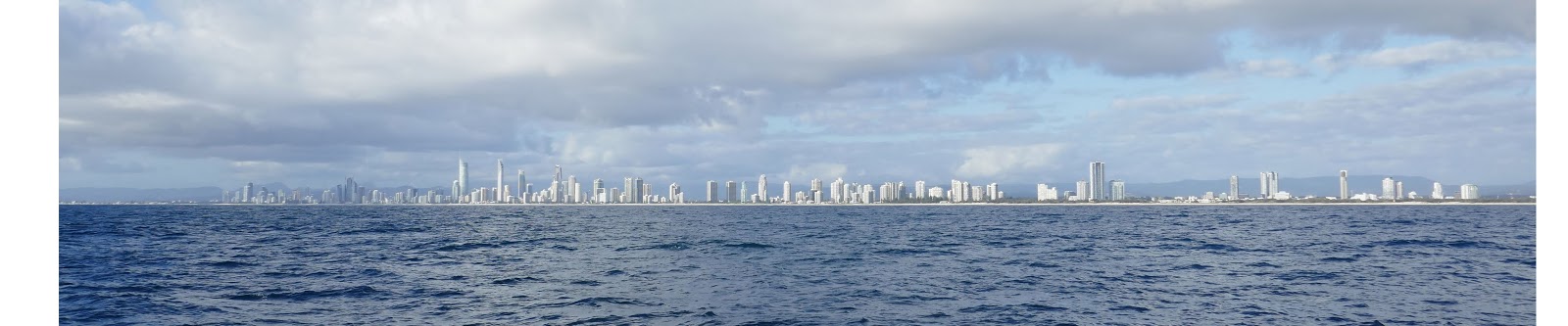
Gold Coast skyline
We set the spinnaker and sailed as high as possible to get out to deep water and into the East Australian Current (of Finding Nemo fame). 
Our instruments showed a water temperature of about 22 deg at the Seaway and as we headed further offshore we saw that temperature rise to 27 deg. The EAC is a bonus when sailing south – regularly giving an extra 2-3 knots of boatspeed. You can see the current on websites such as Windy.com and it is well worth finding it for the journey south and obviously avoiding when coming home.
At 1300 we were abeam of Cape Byron and 1700 Yamba. We dropped the spinnaker then as the wind had increased to over 20 knots.  We put a double reef in the main and were still seeing double digit speeds on occasions. Our high speeds attracted a small group of dolphins who delighted us for several hours – jumping out of the water, doing back flips and playing “chicken” with each other across the bows.
At 2300, the wind had eased and we headed towards Coffs Harbour, arriving at 0200 on Friday morning and tied up at the marina. We had covered 160 nm but had only 130 nm on the log, the EAC had given us the extra 30 miles. A trip time of 19 hours and an average of 8.4 knots.
We had 3 days in Coffs with very strong northerlies on Friday, and southerlies on Saturday and Sunday. We got a workout on the bikes every day. 
There was a nice cycle path along the creek into town and also one down to the trendy town of Sawtell to the south. We rode out to the Rock Pool but as it was looking a bit green I decided to have a dip in the ocean instead. The water was very refreshing!
On our last night we caught up for a BBQ with Adriana and Rob (Deeper Blue) who we had cruised with to the Louisiades, PNG in 2012. It was a great way to finish our time in Coffs. Northerlies were coming again on Monday so we were leaving to continue our journey south.
View from the lookout - had to push the bikes up that hill